

Digital Marketing in 2026: Strategies That Help Businesses Grow Online
Introduction: Marketing Has Gone Digital
The way businesses market their products and services has changed dramatically over the last decade. Traditional methods such as newspaper advertisements, flyers, billboards, and television commercials still have their place, but digital marketing has become the primary channel through which businesses attract, engage, and convert customers.
Today’s consumers spend a significant portion of their time online. They search for products on Google, interact with brands on social media, watch videos, read blogs, check reviews, and make purchasing decisions through digital platforms. As a result, businesses that invest in digital marketing gain greater visibility, stronger customer relationships, and increased opportunities for growth.
However, successful digital marketing is not just about running advertisements or posting on social media. It requires a strategic combination of channels, content, technology, and analytics working together to achieve measurable business objectives.
Most importantly, every successful digital marketing strategy requires a strong foundation—a professional website that converts visitors into customers.
Let’s explore the key digital marketing strategies that are helping businesses grow in 2026.
What Is Digital Marketing?
Digital marketing refers to promoting products, services, and brands through online channels.
These channels include:
- Search Engines
- Websites
- Social Media Platforms
- Email Marketing
- Online Advertising
- Content Marketing
- Mobile Applications
The goal is simple:
- Increase visibility
- Generate leads
- Drive sales
- Build brand awareness
- Improve customer engagement
Unlike traditional marketing, digital marketing provides measurable results, allowing businesses to track performance and optimize campaigns continuously.
Why Digital Marketing Matters More Than Ever
Consumer behavior has shifted dramatically.
Before making a purchase, most customers:
- Search online
- Compare competitors
- Read reviews
- Visit websites
- Check social media profiles
If your business is not visible during this process, potential customers may never discover you.
Digital marketing helps businesses:
Reach Larger Audiences
Businesses are no longer limited by geography.
Generate Qualified Leads
Target customers actively searching for solutions.
Build Brand Recognition
Consistent visibility improves awareness and trust.
Increase Revenue
More visibility often leads to more opportunities and sales.
Measure Performance
Analytics help businesses understand what works and what doesn’t.
Search Engine Optimization (SEO)
SEO remains one of the most powerful digital marketing strategies.
SEO involves optimizing websites to rank higher in search engine results.
When potential customers search for services related to your business, SEO helps your website appear in front of them.
Types of SEO
On-Page SEO
Optimizing website content through:
- Keywords
- Meta descriptions
- Headings
- Internal linking
- Image optimization
Technical SEO
Improving website performance through:
- Faster loading speeds
- Mobile responsiveness
- Security enhancements
- Site architecture
Local SEO
Helping businesses appear in location-based searches.
Examples:
- Restaurants
- Clinics
- Educational institutions
- Service providers
Benefits of SEO
- Long-term visibility
- Higher website traffic
- Increased credibility
- Better lead generation
- Improved return on investment
SEO is often considered one of the most cost-effective marketing strategies available.
Social Media Marketing
Social media has become a central part of modern marketing.
Businesses use social platforms to:
- Build communities
- Engage customers
- Promote products
- Increase brand awareness
Facebook Marketing
Facebook remains valuable for:
- Local businesses
- Community engagement
- Advertising campaigns
Benefits include:
- Audience targeting
- Lead generation
- Customer interaction
Instagram Marketing
Instagram focuses heavily on visual content.
Ideal for:
- Fashion brands
- Restaurants
- Personal brands
- E-commerce businesses
Popular content formats include:
- Reels
- Stories
- Product showcases
LinkedIn Marketing
LinkedIn is the leading platform for professional networking.
Ideal for:
- B2B businesses
- Consultants
- Agencies
- Corporate organizations
Benefits include:
- Lead generation
- Professional branding
- Industry authority
YouTube Marketing
Video content continues to dominate online engagement.
Businesses use YouTube for:
- Tutorials
- Product demonstrations
- Educational content
- Brand storytelling
Video marketing often achieves higher engagement rates than text-based content.
Content Marketing
Content marketing focuses on creating valuable information that attracts and educates audiences.
Instead of directly selling products, businesses provide useful content that builds trust and authority.
Blog Articles
Blogs help businesses:
- Improve SEO
- Answer customer questions
- Establish expertise
- Generate organic traffic
High-quality blog content continues delivering value for years.
Educational Resources
Examples include:
- Guides
- Tutorials
- E-books
- Case studies
Educational content positions businesses as trusted industry experts.
Video Content
Video content can:
- Explain complex concepts
- Demonstrate products
- Increase engagement
Consumers increasingly prefer video over traditional content formats.
Email Marketing
Despite the growth of social media, email marketing remains one of the highest-performing marketing channels.
Email allows businesses to communicate directly with customers.
Uses of Email Marketing
Lead Nurturing
Guide potential customers through the buying journey.
Customer Retention
Maintain relationships with existing customers.
Promotions
Announce offers, discounts, and updates.
Newsletters
Share valuable content and industry insights.
Benefits
- Personalized communication
- High return on investment
- Strong customer relationships
- Better customer retention
Email marketing remains a powerful tool for long-term business growth.
Pay-Per-Click Advertising (PPC)
PPC advertising allows businesses to appear instantly in front of targeted audiences.
Unlike SEO, PPC generates immediate visibility.
Google Ads
Google Ads display businesses at the top of search results.
Benefits include:
- Immediate traffic
- High-intent visitors
- Measurable performance
Social Media Advertising
Platforms like Facebook and Instagram offer advanced targeting options.
Businesses can target users based on:
- Location
- Interests
- Behavior
- Demographics
This precision helps maximize advertising efficiency.
Benefits of PPC
- Immediate visibility
- Faster lead generation
- Scalable campaigns
- Detailed analytics
When managed properly, PPC can generate significant returns.
Online Reputation Management
Customers often research businesses before making decisions.
Reviews and online reputation influence purchasing behavior.
Businesses should actively manage:
- Google Reviews
- Social Media Feedback
- Customer Testimonials
- Online Mentions
Benefits
- Increased trust
- Better credibility
- Improved customer confidence
A strong online reputation often becomes a competitive advantage.
Conversion Rate Optimization (CRO)
Generating traffic is only part of the marketing process.
Businesses must also convert visitors into customers.
Conversion Rate Optimization focuses on improving:
- Landing pages
- Forms
- Calls-to-action
- User experiences
Even small improvements can significantly increase revenue.
Analytics and Performance Tracking
One of digital marketing’s greatest advantages is measurability.
Businesses can track:
- Website visitors
- Traffic sources
- Conversion rates
- Customer behavior
- Campaign performance
Popular metrics include:
- Leads generated
- Sales completed
- Cost per acquisition
- Return on investment
Data-driven decision-making helps businesses improve results continuously.
Artificial Intelligence in Digital Marketing
Artificial Intelligence is transforming marketing strategies worldwide.
AI helps businesses:
Personalize Content
Deliver relevant experiences based on customer behavior.
Automate Campaigns
Reduce manual effort through intelligent automation.
Improve Customer Support
AI-powered chatbots provide instant assistance.
Predict Customer Behavior
Advanced analytics improve marketing effectiveness.
Businesses adopting AI gain efficiency and competitive advantages.
The Importance of a Website in Digital Marketing
Many businesses focus heavily on advertising and social media but overlook one critical element:
Their website.
A website acts as the destination for nearly all digital marketing efforts.
Consider this customer journey:
- Customer sees an ad.
- Customer clicks the link.
- Customer visits the website.
- Customer decides whether to trust the business.
If the website is slow, outdated, confusing, or poorly designed, marketing investments may be wasted.
A professional website supports:
- SEO
- PPC campaigns
- Social media traffic
- Email marketing
- Lead generation
- Customer conversions
Without a strong website, digital marketing rarely reaches its full potential.
Building an Integrated Marketing Strategy
The most successful businesses combine multiple channels.
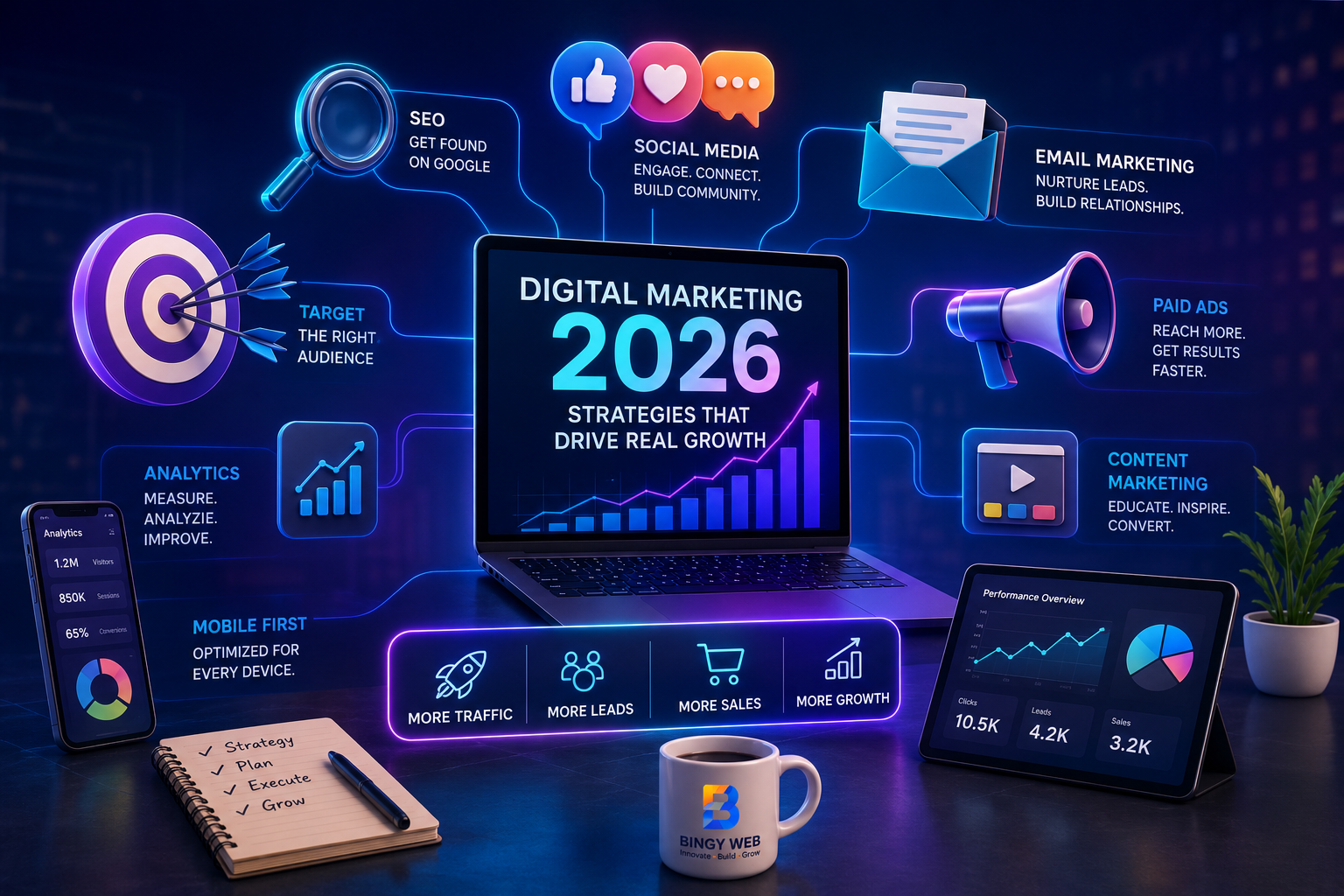
An integrated strategy may include:
- Website Optimization
- Search Engine Optimization
- Content Marketing
- Social Media Marketing
- Email Campaigns
- Paid Advertising
- Analytics Monitoring
Together, these channels create a comprehensive system for attracting, nurturing, and converting customers.
Future Trends in Digital Marketing
The marketing landscape continues evolving.
Emerging trends include:
AI-Powered Personalization
Highly customized customer experiences.
Voice Search Optimization
Growing use of voice assistants.
Video-First Marketing
Short-form and long-form video content.
Marketing Automation
Streamlined campaign management.
Omnichannel Experiences
Seamless interactions across multiple platforms.
Businesses that adapt quickly will remain competitive and continue growing.
Conclusion: Grow Your Business with Digital Marketing and Bingy Web
Digital marketing has transformed the way businesses connect with customers. Search engines, social media, content marketing, email campaigns, online advertising, and analytics all play critical roles in building visibility, generating leads, and increasing revenue. However, every successful marketing strategy depends on one essential foundation—a professional website.
A website is where visitors become customers, inquiries become opportunities, and marketing investments produce measurable results. Without a well-designed, fast, secure, and optimized website, even the best marketing campaigns struggle to achieve their full potential.
At Bingy Web, we understand that modern marketing begins with a powerful digital presence. We create websites designed to support SEO, social media marketing, paid advertising, lead generation, and customer engagement. Our solutions help businesses attract more visitors, improve conversions, and achieve sustainable growth.
Today’s marketing needs a website for business growth. That foundation will be fulfilled by Bingy Web—helping businesses build their online presence, strengthen their brand, and unlock their full digital potential in 2026 and beyond.